
Blooming
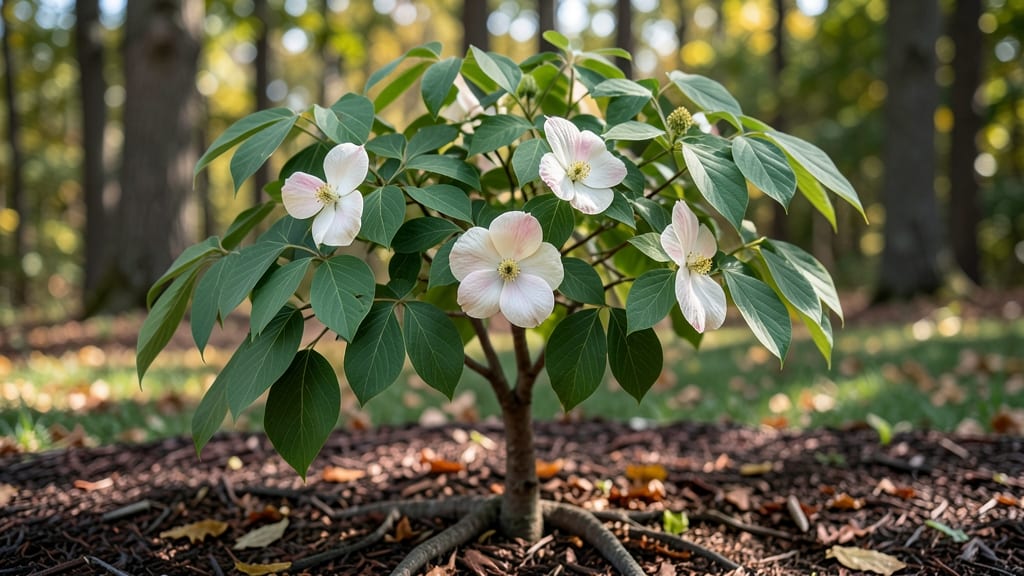
A dogwood bloom looks like four delicate, creamy-white or soft pink bracts that form a perfect cross shape around a tiny, yellow-green center of true flowers. This striking arrangement gives it a four-petaled appearance that's instantly recognizable in spring gardens.
A dogwood bloom's most fascinating feature is how its showy bracts—those leaf-like structures—actually aren't the true flowers. 🌸 These modified leaves frame the real blossoms hidden at the center, creating that iconic four-pointed star shape.
The contrast between the pale outer bracts and the tiny central flowers makes dogwoods stand out against other spring bloomers like magnolias or cherries, which have more uniform petals. This unique structure also helps the plant attract pollinators while protecting its delicate true flowers from harsh weather.
The color variations add to their charm—early blooms often appear pale pink, deepening to nearly white as the season progresses. 🌿 Sun exposure plays a big role: shade-loving varieties like Cornus kousa tend to stay lighter, while sun-drenched Cornus florida might develop richer pink hues.
Pro tip: The bracts' color fades after blooming, revealing the plant's distinctive red berries later in the season.
💡 In This Article
- Identifying Dogwood Bracts vs True Flowers
- Seasonal Color Variations in Dogwood Blooms
Identifying dogwood bracts vs true flowers
The dogwood's signature "four-petaled" appearance comes from its modified leaves called bracts, not true flowers. These bracts develop from the plant's stem tissue and function like petals to attract pollinators, but they're actually specialized leaves.
Each bract is about 1-2 inches wide with smooth, waxy edges that reflect light, making them stand out against the darker stems. 🌸
At the center lies the true flowers—tiny, greenish-yellow clusters about 1/4 inch wide—that produce the plant's berries. The contrast between the showy bracts and these modest flowers creates the dogwood's signature silhouette.
Unlike magnolias (which have true petals) or cherries (with uniform petal rings), dogwoods use this bract strategy to protect their delicate reproductive structures while maximizing visibility to pollinators.
This structure also explains why dogwoods bloom earlier than many trees—the bracts develop first to catch sunlight, while the true flowers mature more slowly. The bracts' position at 90-degree angles creates that perfect cross shape, a feature botanists call "tetrahedral symmetry."
This geometric precision makes dogwoods instantly recognizable even from a distance.
Another key difference is texture: the bracts feel slightly leathery to the touch, while the true flowers have a fine, almost fuzzy surface. When you examine a bloom closely, you'll notice the bracts have subtle veins running through them—like delicate lacework—while the central flowers appear more clustered and dense.
This contrast helps distinguish dogwoods from similar-looking blooms like serviceberries, which have true petals with different structural patterns.
What most people don't realize is how this bract-flower arrangement serves a survival function. The bracts act as a "sun shield," protecting the true flowers from late frost damage while still allowing pollinators access.
This dual-layered structure is why dogwoods thrive in USDA zones 5-9, where spring temperatures can fluctuate dramatically. The bracts' early development gives the plant a head start in the pollination race.
For gardeners, this botanical quirk means you can identify dogwoods even when they're not in bloom by looking for the characteristic opposite branching pattern (leaves grow directly across from each other) and the distinctive red berries that follow the flowers.
The berries develop from those tiny central flowers, while the bracts wither away after blooming—another clue to the plant's unique reproductive strategy.