
Blooming
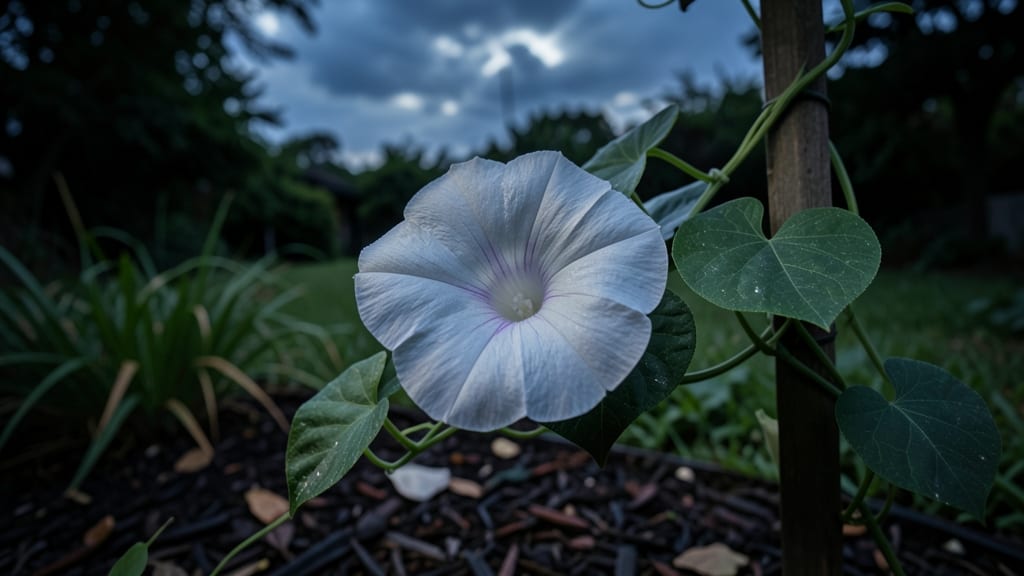
Moon flowers bloom at night to attract moth pollinators with their large white petals, which become most visible under moonlight. Their blooming cycle is controlled by internal clocks and light sensitivity, reaching peak visibility after dark.
These night-blooming beauties evolved this way because moths—their primary pollinators—are most active after sunset. 🌙 The flowers' white petals reflect moonlight perfectly, making them stand out to foraging moths while avoiding daytime predators.
Unlike sunflowers that rely on bees, moonflowers sync their opening with the lunar cycle, typically unfolding around 8 PM and wilting by dawn. This timing also helps conserve energy during cooler nighttime temperatures.
Interestingly, you can encourage more frequent blooms by planting them in low-light areas of your garden, away from harsh afternoon sun. They thrive in well-draining soil and benefit from regular watering—especially during their growing season in late spring to summer.
Adding companion plants like evening primrose or jasmine nearby can boost pollinator activity, giving your moonflowers even better chances to shine (literally) under the night sky.
💡 In This Article
- The Science Behind Nocturnal Moonflower Blooming
- Tips to Encourage Moonflowers to Bloom at Night
The science behind nocturnal moonflower blooming
Moonflowers (Ipomoea alba) have evolved a fascinating biological mechanism called circadian rhythm, their internal 24-hour clock that regulates when they open and close. Unlike day-blooming flowers like roses or sunflowers, which rely on sunlight to trigger photosynthesis and attract bees, moonflowers respond to the natural light-dark cycle.
Their petals begin to unfurl around 7-9 PM when ambient light levels drop below 100 lux—about the brightness of a dimly lit room. This sensitivity is governed by specialized proteins called phytochromes, which detect light wavelengths and signal the plant's internal clock to initiate blooming.
The flowers' white color isn't just for show—it's a strategic adaptation. Moonflowers reflect up to 85% of moonlight, creating a stark contrast against the dark night sky that moths can detect from 10-15 feet away.
This high visibility is crucial because their primary pollinators, like the white-lined sphinx moth, have eyes optimized for low-light conditions.
The flowers also emit a faint, sweet fragrance that becomes more pronounced after dark, peaking around 10 PM when moth activity is highest. 🌙 Interestingly, the scent contains compounds like benzyl acetate, which mimics the pheromones moths use to locate mates, making the flowers even more irresistible.
Temperature plays a surprising role too. Moonflowers typically bloom when nighttime temperatures stay above 60°F (15°C), as cooler nights can slow their metabolic processes. This is why they're most reliable in warmer climates or during summer months.
The flowers also close by dawn to conserve moisture and energy, as daytime evaporation rates can exceed 0.5 milliliters per hour from exposed petals. This rapid opening-and-closing cycle—sometimes completing in just 12 hours—demonstrates how perfectly moonflowers have adapted to their nocturnal lifestyle.
Comparing them to day-blooming flowers reveals their unique evolutionary path.
While sunflowers might produce 1,000-2,000 flowers per season and rely on bees for pollination, a single moonflower vine can produce 50-100 blooms per season but with a much higher pollination success rate—up to 90% efficient due to their specialized moth partnerships.
This trade-off highlights nature's efficiency: moonflowers invest energy in fewer, high-impact blooms rather than numerous daytime flowers that might go unpollinated.
What's particularly fascinating is how moonflowers "know" when to bloom. Research shows their circadian clocks can anticipate the solar cycle with ±30-minute accuracy, even without external light cues. This internal timing mechanism allows them to bloom consistently night after night, regardless of weather variations.
The flowers' stems contain specialized cells called pulvini that regulate movement by adjusting turgor pressure—like a natural hydraulic system that unfurls the petals at precisely the right moment. 🌟
This nocturnal strategy isn't just about pollination—it's also a survival tactic. By blooming at night, moonflowers avoid daytime predators like deer and rabbits that might eat their delicate petals.
The flowers' rapid wilting by morning also prevents them from becoming food sources for birds or insects that are active during the day. This dual-purpose adaptation—maximizing pollination while minimizing damage—shows how evolutionary pressures have shaped moonflowers into true nighttime specialists.