
Blooming
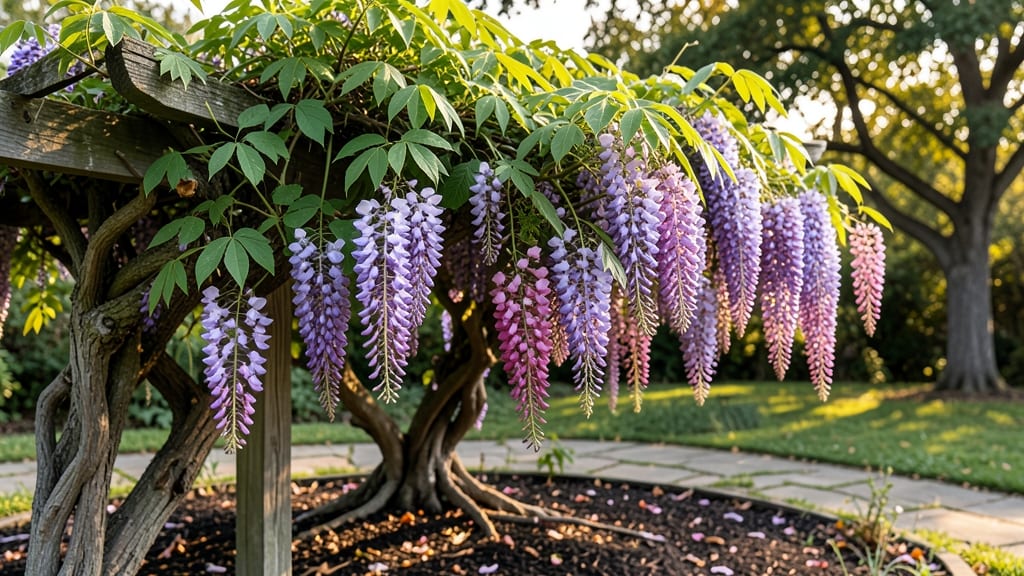
Wisteria blooms every year once mature, though it usually takes 3-5 years of growth before producing flowers. Annual spring blooms occur in healthy plants, but consistent flowering depends on proper care like pruning, sunlight exposure, and soil health.
Wisteria's flowering cycle is all about patience and preparation. 🌸 Young plants focus their energy on root and vine development, often delaying blooms until they've established a strong foundation.
This explains why some gardeners wait years before seeing those iconic cascading flowers—it's not a sign of poor health, but rather a natural growth phase.
Once mature, though, wisteria can reward you with spectacular annual displays, provided you meet their needs for well-draining soil and at least 6 hours of sunlight daily.
What many don't realize is that different varieties bloom at different rates. For example, Chinese wisteria often flowers earlier than Japanese varieties, sometimes as early as 2 years under ideal conditions.
The key to encouraging consistent annual blooms lies in strategic pruning after flowering—this redirects the plant's energy toward next year's blossoms rather than excessive foliage growth.
💡 In This Article
- Why Wisteria Takes Years to Bloom and How Growth Stages Affect Flowers
- Proven Techniques to Speed Up Wisteria Flowering and Maintain Annual Blooms
Why wisteria takes years to bloom and how growth stages affect flowers
Wisteria's delayed flowering is rooted in its natural growth strategy. During the first 3-5 years, the plant prioritizes developing an extensive root system and sturdy vines—sometimes growing 10-15 feet per year—before allocating energy to flowers.
This juvenile phase is similar to fruit trees that delay fruiting until they've established a strong framework. The plant's primary focus shifts only when it reaches mature size (typically 5-10 years old), at which point it can support the energy demands of flowering.
The biological mechanism involves hormonal regulation. Young wisteria produces high levels of auxin, a growth hormone that suppresses flowering while promoting vine elongation. As the plant matures, auxin levels decrease while florigen—a flowering hormone—becomes dominant during spring.
This hormonal shift explains why even well-cared-for wisteria may take years to bloom: the plant must first build sufficient biomass to sustain the energy-intensive process of flower production, which can require 30-50% of its annual energy budget.
Climate plays a critical role in this process. Wisteria native to temperate zones requires winter chilling (500-1,000 hours below 45°F) to break dormancy and trigger spring flowering. Without adequate cold exposure, the plant may produce fewer blooms or skip flowering entirely.
This is why wisteria grown in warm climates (like Florida) often flowers less reliably—it's not just about age, but also about satisfying the plant's physiological needs for seasonal cues.
What most gardeners overlook is how growth rate affects flowering potential. Fast-growing varieties (like Wisteria floribunda) may flower earlier but often produce weaker blooms, while slower-growing types (like Wisteria sinensis) invest more energy per flower.
The trade-off is that faster growers require more aggressive pruning to maintain bloom quality, while slower growers need patience but reward with more robust displays over time.
Soil quality directly impacts this timeline. Wisteria thrives in well-draining soil with a pH of 6.0-7.5, where nutrients are readily available for root development. Poor soil forces the plant to divert energy to nutrient acquisition rather than flowering, potentially delaying blooms by 1-2 additional years.
The root system must reach depths of 3-5 feet before the plant can support abundant flowering, which is why heavy clay soils often result in sparse or delayed blooms.
Once mature, wisteria's annual flowering becomes more predictable, but only if the plant receives consistent care. The first blooms typically appear on older wood (last year's growth), which is why improper pruning can reduce future flowering.
Understanding this growth cycle helps explain why some wisteria plants bloom spectacularly one year and poorly the next—it's not random, but a response to the plant's energy balance between growth and reproduction.