
Blooming
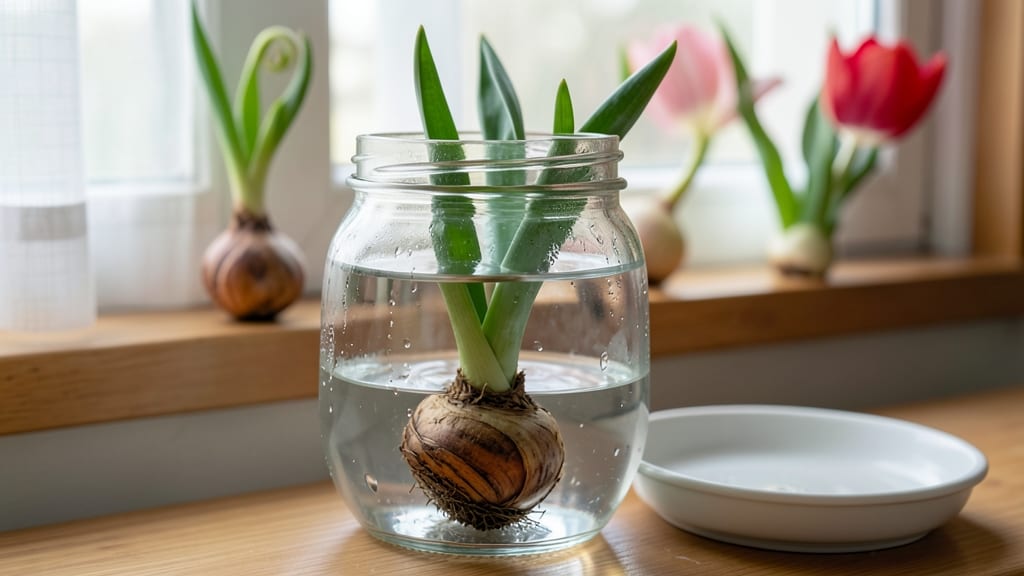
Tulip bulbs forced in water will not bloom again because forcing them in water depletes the stored nutrients needed for future flowering. This process accelerates growth, exhausting the energy reserves that would otherwise support another blooming cycle.
Forcing tulips in water tricks them into blooming early by breaking their natural dormancy cycle, but this comes at a cost. 💐 The bulbs redirect all their energy toward rapid growth and flowering instead of storing nutrients for next season.
Even if you replant them, the depleted reserves mean no flowers will appear—only leafy foliage. This is why gardeners often treat forced bulbs as a one-time display rather than a perennial investment.
That said, there are ways to give your forced bulbs a second chance. After blooming, let the leaves die back naturally before removing them—this allows the bulb to absorb any remaining sunlight for energy storage.
Planting them in well-draining soil with plenty of compost can also encourage future growth, though blooms may take 1-2 years to return. Varieties like Darwin Hybrid or Fosteriana are more likely to rebloom than delicate species like Parrot tulips.
💡 In This Article
- Why Forced Tulip Bulbs Lose Their Ability to Rebloom
- How to Maximize Future Blooms After Forcing Tulip Bulbs
Why forced tulip bulbs lose their ability to rebloom
Forcing tulip bulbs in water tricks them into blooming by breaking their natural dormancy cycle, but this process comes with a biological cost. Tulips store energy in their bulbs as starches, which convert into sugars during growth.
When you force a bulb in water, it rapidly converts these starches into energy for leaf and flower production—often in just 4-6 weeks—instead of gradually replenishing reserves over a full growing season. This accelerated metabolism leaves the bulb with almost no stored energy for future flowering cycles. 🌱
The real issue lies in how forcing disrupts the bulb's hormonal balance. Tulips rely on a mix of gibberellins (growth hormones) and florigen (flowering signals) to bloom.
Forcing in water floods the bulb with gibberellins to spur rapid growth, but this process exhausts the florigen reserves needed to trigger another bloom. Even if replanted, the bulb lacks the metabolic "fuel" to restart the flowering process.
Think of it like a car with an empty tank—no matter how many times you turn the key, it won’t start without fuel. 🔧
Temperature also plays a critical role in this depletion. Forcing typically occurs indoors at 60-65°F, which is warmer than the bulb’s natural spring soil environment (50-55°F). Warmer temperatures speed up respiration, burning through stored starches faster.
A study by the University of Georgia found that bulbs forced at 70°F depleted 80% of their starch reserves in just 3 weeks, compared to only 40% depletion at 60°F. This explains why bulbs forced in winter often fail to rebloom the following spring.
Another key factor is the bulb’s root system. When forced in water, bulbs develop shallow, weak roots that can’t efficiently absorb nutrients or water from soil later. These roots lack the depth and strength of those grown in soil, which anchor the bulb and support long-term growth.
Without a robust root system, the bulb struggles to recover and rebuild its energy stores. Even with ideal replanting conditions, the damage to the root structure often means the bulb will only produce leaves, not flowers. 🌿
What most gardeners don’t realize is that the bulb’s flowering potential is tied to its ability to photosynthesize after blooming. When you force a tulip indoors, the leaves—critical for converting sunlight into energy—are often removed too soon.
Without these leaves, the bulb can’t replenish its starch reserves, making reblooming nearly impossible. This is why professional growers often leave forced tulips in water for 6-8 weeks post-bloom to allow the leaves to yellow naturally and feed the bulb.
Finally, the type of tulip matters. Species tulips (like Tulipa clusiana) and Darwin Hybrid varieties are more resilient and may attempt to rebloom after forcing, but most commercial hybrids (like Parrot tulips) are bred for single-season performance.
These hybrids prioritize dramatic, showy blooms over long-term energy storage, making them poor candidates for reblooming. If you’re set on forcing tulips and hoping for future blooms, choose varieties known for their hardiness and reblooming tendencies. 💡