
Blooming
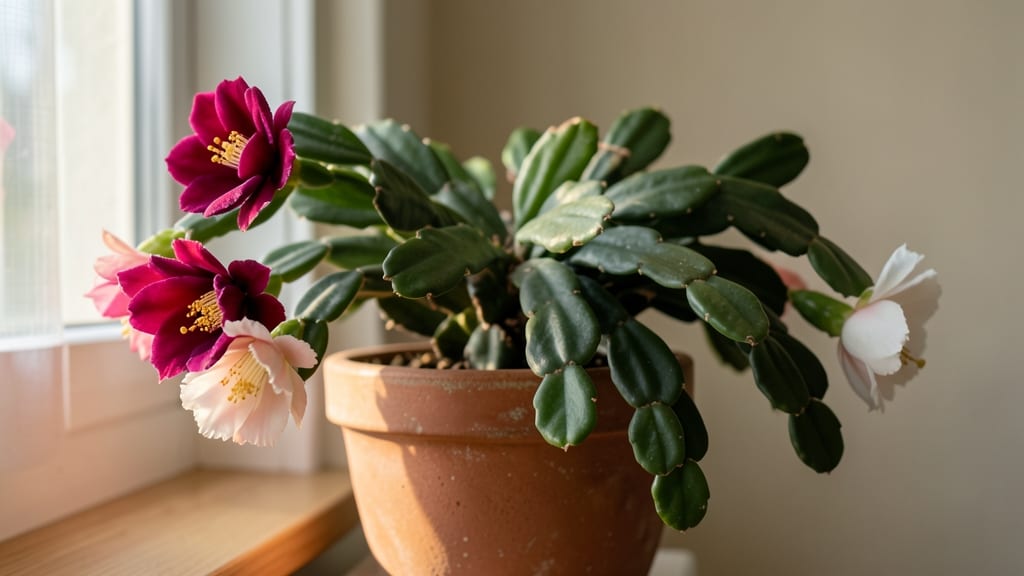
The vibrant Christmas cactus bloom colors—pink, red, and white—stem from anthocyanin and flavonoid activity, shaped by light exposure, soil chemistry, and genetics. Most varieties lean pink due to balanced pigment production, while deep reds signal higher anthocyanin concentration, and whites simply lack these pigments entirely.
The color show in your Christmas cactus isn't just pretty—it's science in bloom! 🌸 Anthocyanins, those natural pigments that also color berries and autumn leaves, are what give pink and red hues their intensity.
When your plant gets bright indirect light, it produces more of these pigments, deepening the colors. Meanwhile, soil pH plays a sneaky role: slightly acidic conditions (around 6.0-6.5) enhance red tones, while neutral soil keeps whites pristine.
Genetics determine the baseline—some varieties are hardwired for bold reds, while others naturally produce softer pinks or pure whites.
What's fascinating is how these factors interact. For example, a red Ruby variety might bloom with deeper crimson in cooler weather, while the same plant could produce softer pinks in summer heat. 💫 Even white blooms aren't completely pigment-free—they just express flavonoids differently, creating that crisp, clean look.
The key takeaway? Your growing conditions can subtly shift the color palette of your plant's natural genetics!
💡 In This Article
- How Light and Soil Affect Christmas Cactus Bloom Pigmentation
- Best Christmas Cactus Varieties for Vibrant Bloom Colors
How light and soil affect Christmas cactus bloom pigmentation
The vibrant hues of Christmas cactus blooms start with light exposure, which triggers anthocyanin production. These pigments act like natural sunscreen, protecting the plant from UV damage while creating stunning colors. When your plant receives bright, indirect light (1,000-2,000 foot-candles), it produces more anthocyanins, deepening pinks and reds.
In low light (500 foot-candles), blooms often fade to pale pink or white because pigment synthesis slows down. 🌿 For example, a 'Christmas Carol' variety might show vibrant magenta blooms in a south-facing window but revert to soft pinks in a dim corner.
Soil pH plays a crucial role too—acidity levels directly impact pigment intensity. Most Christmas cacti thrive in slightly acidic soil (pH 6.0-6.5), which enhances red tones by stabilizing anthocyanin molecules.
Test your soil: if the pH dips below 5.5, red varieties like 'Red Ruby' may develop muddy hues, while whites like 'White Christmas' could turn yellowish. The ideal balance keeps colors vibrant and true to the plant's genetic potential.
Think of it like adjusting the saturation on a photo—too acidic or alkaline, and the colors become washed out.
Genetics set the baseline, but environmental factors fine-tune the final palette. For instance, white blooms aren't colorless—they simply express flavonoids differently, creating a crisp, clean appearance. These compounds reflect all light wavelengths equally, giving whites their purity.
Meanwhile, pink varieties like 'Christmas Eve' often contain both anthocyanins and flavonoids, blending to create their signature soft hues. The interplay between these pigments explains why some plants produce gradient blooms with pink edges fading to white centers. 💫
Temperature also influences color development—cooler nights (60-65°F) enhance anthocyanin production, while warmer conditions (> 75°F) can mute pigment intensity. This is why many growers recommend a 10-14 day cooling period (50-55°F) before blooming to intensify colors.
The plant essentially "preps" for its floral display, producing more pigments in response to the temperature shift. It's nature's way of ensuring vibrant blooms when conditions are optimal.
Artificial lighting can help too, but quality matters. LED grow lights with a red-blue spectrum (660nm/450nm wavelengths) mimic natural sunlight and boost pigment production. Place lights 6-12 inches above the plant for 12-14 hours daily during winter months.
Avoid cheap bulbs—inefficient lighting can stress the plant, leading to weaker blooms. The key is replicating the natural light cycle that triggers anthocyanin synthesis without overheating the leaves.
What most growers don't realize is how soil nutrients interact with these pigments. Magnesium and phosphorus deficiencies can cause color fading, while excess nitrogen promotes leafy growth at the expense of vibrant blooms.
Use a balanced 20-20-20 fertilizer during the growing season, but reduce nitrogen in fall to encourage flowering. The right balance ensures your plant directs energy toward pigment production rather than foliage. 🌸